


When the Homeland Becomes a Poem, and the Poem Becomes a Homeland
Poetry does not write places in the way geography books do, nor does it depict them as maps do or capture them through the lenses of photographers. When place enters the space of poetry, it loses its physical boundaries and becomes an emotional state, a living memory, and a system of symbols, images, and affects that reshapes the relationship between human beings and the world. Great cities, therefore, do not live only in history; they also live in poetry, because the poem is the form of memory most capable of rescuing places from disappearance, granting them a second life within the human consciousness. From Homer, through Dante, Lorca, and Neruda, to modern poets, place has remained one of the major structures underlying poetic writing, because it is not merely a framework for events, but one of their true protagonists.
Within this aesthetic horizon emerges the experience of the Italian poet Anna Maria Gallo in her collection Voices of the Medina. This work cannot be regarded merely as a collection of poems inspired by her journeys to Morocco, nor as a touristic text describing cities, markets, and landscapes. Rather, it should be understood as a profound poetic and human experience founded upon the rediscovery of Morocco as a space of meaning, a field for intercultural dialogue, and a mirror in which the European self encounters another dimension of its own humanity. The poet does not enter Morocco through the gateway of exoticism or superficial fascination; instead, she approaches it through attentive listening to the details of everyday life, through listening to the pulse of ordinary people, and through celebrating what is marginal and transient, until the ordinary becomes poetry, the everyday becomes memory, and the visual scene becomes an existential vision.
If most European writings about Morocco since the nineteenth century have been subject, to varying degrees, to what Edward Said called “Orientalist representation,” whereby the East is presented as a space of strangeness, excitement, and difference, Voices of the Medina belongs to an entirely different horizon. Here we encounter a form of writing that does not look upon Morocco as the “Exotic Other,” but rather as a partner in the human experience. Hence, the poet does not write primarily about what attracts the eye, but about what touches the heart. She does not dwell at length on the magnificence of palaces or the uniqueness of tourist landmarks; instead, she moves closer to people, markets, the aroma of tea, the silence of the desert, the faces of artisans, women weaving wool in a mountain village, an elderly man sitting in front of his shop, a little girl carrying water from a well deep in the desert, and even the cats of the old city that find refuge and compassion in an ordinary woman. In this way, the poem becomes a form of symbolic justice, giving voice to those whom official history does not hear.
The first thing that draws attention in this collection is that Morocco does not appear as an external subject, but as an inner experience. The poet does not merely describe what she saw; she rewrites what she lived. Between seeing and living lies an immense aesthetic distance, because seeing may remain superficial and fleeting, whereas living presupposes emotional involvement and immersion in the details of place. The poems therefore seem not to retrieve scenes preserved in memory, but to summon an entire life that continues to pulsate within the poet, even more than three decades after her first journey to Morocco. Time, in this collection, does not erase experience; rather, it consolidates it. Memory does not function as an archive of the past, but as a creative energy that reproduces the past within the present and grants it a new significance.
The title of the collection, Voices of the Medina, therefore acquires particular symbolic importance. The poet does not choose the word “medina” merely because it refers to an urban space, but because it points to a cultural and human entity in which voices, smells, colors, languages, and stories intersect. As for the “voices,” they do not signify noise, but memory. They are the voices of the people she encountered, the voices of markets, the call to prayer, the rustling of palm trees, the footsteps of passers-by, the hammer blows of a zellij artisan, and even the profound silence inhabiting the desert. The city here is not merely seen; it is also heard, as if the poet wishes to affirm that knowledge of places is not achieved through sight alone, but through all the senses.
Great cities are not made of stones alone; they are made by the voices that inhabit them. The voice of the muezzin cutting through the silence of the night; the voices of the women weavers in Asni as they transform wool into memory; the voices of children playing in narrow alleys; footsteps upon the stones of the old city; the voices of vendors in the markets; the sound of the wind crossing the desert; and even the voice of silence itself as it settles among the walls of old riads. Thus, the city becomes, in this collection, a breathing being that remembers, dreams, grieves, and gives its inhabitants a part of its soul.
It is no coincidence that the poems repeatedly invoke words such as wind, desert, dust, light, sunset, palm trees, zellij, couscous, tea, the call to prayer, markets, alleys, mountains, the Atlas, cats, children, and women weavers. These words do not perform a decorative function; rather, they constitute an integrated symbolic lexicon in which everyday objects become cultural and spiritual signs. Couscous, for example, does not appear merely as a traditional dish, but as a social ritual that restores human relationships every Friday. The desert is not a geographical void, but an image of the soul searching for itself. The old city is not merely historic architecture, but an open book spanning centuries of memory. This transformation from description to symbol is what gives the poems their human dimension and liberates them from the danger of folkloric documentation.
The poet’s sensuous orientation is perhaps one of the fundamental characteristics of this collection. The texts do not construct their world through external description, but through a dense network of sensory references: the scent of argan oil, the fragrance of jasmine, the taste of prickly pear, the warmth of mint tea, the roughness of clay, the softness of wool, the blue of zellij, the redness of Marrakech earth, the whiteness of the Atlas snows, and the silence of the sand dunes. Thus, the body, with all its senses, becomes a medium of knowledge, and poetry becomes a perceptual practice that allows human beings to rediscover the world through touch, smell, taste, and listening, rather than through sight alone. This recalls the position of the French philosopher Maurice Merleau-Ponty, who argued that “the body is not merely an instrument of perception, but the primary condition of every relationship with the world.”
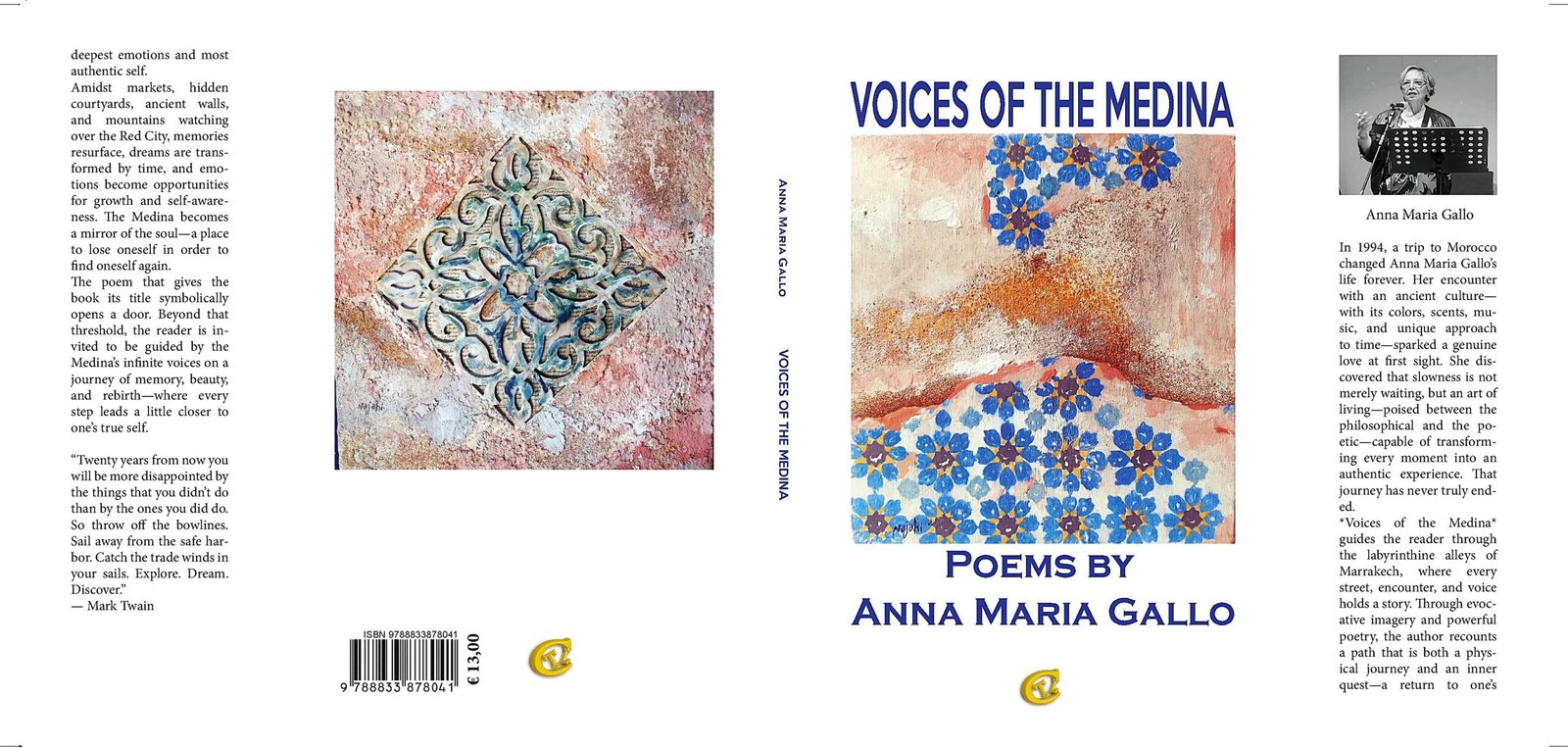
Yet what gives this collection its distinctive character lies not only in the poems themselves, but also in the profound dialogue they establish with the visual artworks of Moroccan artist Mohamed Najahi. The book does not bring poetry and painting together arbitrarily; rather, it establishes what may be called a “composite text,” in which word and color coexist and each becomes an extension of the other. Najahi’s paintings do not explain the poems, just as the poems do not describe the paintings. Instead, the two enter into an interactive relationship in which each discourse illuminates what the other is unable to express. When language falls silent, color speaks; and when color retreats behind abstraction, the poem retrieves it through words.
Another striking feature of this collection is that the poet succeeds in transcending the traditional binary opposition between the “self” and the “Other.” She does not treat Morocco as a different “Other,” but as an extension of herself. The poems therefore do not speak about Moroccans in the third person; rather, they make them partners in the poetic experience. When she writes about the women weavers of Asni, she does not merely describe the movement of their hands; she sees in every knot of the carpet a human story, and in every thread an extension of time. When she writes about “Karima,” she does not present a passing figure from the city, but transforms her into a symbol of silent generosity and of the ability to turn compassion into a way of life. Even the child who gives her a “desert rose” ceases to be an ordinary child and becomes a metaphor for a purity that continues to resist the harshness of the world. This is a form of writing that believes that the human being is the most beautiful thing in a place.
The Poetics of Hospitality: Morocco as an Aesthetic Ethics in Voices of the Medina
There are places that welcome the visitor, and there are places in which the visitor encounters the life that pulses within them. The difference between these two forms of welcome is considerable. In the first, one feels like a passer-by; in the second, one feels as though one is returning to a place one has known for a long time, even if one has never set foot there before. This is precisely the feeling generated in the reader of Voices of the Medina by Anna Maria Gallo. The Morocco she writes is not a country that merely arouses curiosity, nor is it a dazzling tourist spectacle; rather, it is a space of hospitality in the cultural and spiritual sense of the word.
Hospitality here cannot be reduced to offering a glass of mint tea or welcoming a guest into one’s home. It becomes a vision of the world in which the Other becomes an extension of the self rather than its opposite. This idea reverberates, indirectly, throughout most of the poems. In almost every text, we find an open door, an extended hand, a smile, a table, a word of welcome, or some small act of human generosity. The poet does not describe Moroccan hospitality as a social custom, but as a philosophy of life. In doing so, she captures one of the deepest elements of Moroccan culture, where generosity has historically been more than an individual behavior; it has expressed an entire conception of the relationship with the human being, whether the guest comes from the immediate neighborhood or from the farthest reaches of the planet.
Tea… A Cultural Ritual, Not an Everyday Beverage
It may seem strange that tea should appear so frequently in this collection, but in fact it does not perform a merely descriptive function; it performs a symbolic one. Whenever the glass of tea appears, it seems to suspend time, establish a space for dialogue, and reorder the relationship between human beings and the world. In Moroccan culture, tea is not served merely to quench thirst; it announces the beginning of an encounter. It constitutes a time outside practical time: a time of conversation, listening, waiting, and sharing. This is why the poet captures it as a sign of a civilization that believes human relationships are not built through haste, but through deliberation and slowness. The poet does not merely describe the taste of tea; she describes the rhythm it creates. The steam rising from the glass becomes a metaphor for the quiet ascent of memory, while the scent of mint becomes the scent of the place itself, until Morocco as a whole seems capable of being condensed, within a single poetic moment, into a glass of tea from which light and overwhelming flavors rise.
Bread, Tagine, and Couscous… When the Table Becomes a Cultural Text
If tea is the ritual of encounter, then food, in this collection, becomes the ritual of community. Tagine, couscous, and bread are not merely foods; they are signs of a culture that believes sharing begins around the table.
It is striking that the poet does not speak of Moroccan cuisine as a folkloric curiosity, but as a language of family. The tagine that cooks slowly resembles human relationships, which require time in order to mature, while couscous, bringing everyone together around a single dish, becomes a metaphor for unity within diversity. Here, the poetic text intersects with cultural anthropology, as the table becomes a space for producing meaning rather than a space for consumption. Food here carries the memory of mothers and grandmothers, as well as the continuity of rituals that bind generations to one another.
The Moroccan Artisan… An Artist and Philosopher Who Works with His Hands
One of the most prominent figures in the collection is the artisan. Yet he does not appear merely as a maker of commodities or traditional handicrafts, but as a guardian of time. There are also the women weavers of Asni, the zellij craftsman, market vendors, and the bag maker. All of them perform not merely an economic function, but a civilizational one. They transmit knowledge from hand to hand and from generation to generation, until craft itself appears as a form of memory. Through his visual works accompanying the poems in the collection, Mohamed Najahi has perceptively captured this dimension. His paintings celebrate not so much the finished product as the trace of the hand. The brushstrokes, the roughness of the surface, and the overlapping layers of color all make the painting itself appear as a craftwork rather than an industrial product. It is as though the artist, like the poet, wishes to say that the value of art does not lie solely in technical perfection, but in the human trace that the hand leaves upon matter.
The Moroccan Woman… From a Folkloric Image to a Symbol of Creation and Continuity
The image of the woman is among the most recurrent images in the collection, yet she is not presented as an object of external beauty, nor as a secondary character revolving around the man, but as a center of life. When Amal sews her caftan from scraps of fabric, she transforms poverty into creativity. When Amina watches over the well, she transforms water into memory. When Karima feeds the cats, she transforms care into a mission. When the women weavers weave wool, they weave time itself along with it. In these poems, woman is not a symbol of adornment, but a symbol of creation. She preserves rituals, transmits memory, and patiently reproduces everyday life in ways that often remain unseen. Her presence therefore acquires a civilizational dimension, because the poet regards her as one of the silent pillars upon which society rests.
This approach does not proceed from a purely literary reading, nor from an isolated visual-art perspective. Rather, it emerges from a critical conception that regards this collection as a unified aesthetic project in which poetry intersects with visual art, memory with place, and Moroccan culture with universal human consciousness. The objective here, therefore, has been to analyze the poetic and aesthetic structures underlying the collection and to reveal how Morocco, in Anna Maria Gallo’s experience, is transformed from a geographical space into a symbolic space, and from an object of writing into an active subject within it. It was equally necessary to pause before Mohamed Najahi’s visual works, understood as a visual discourse parallel to the poem that deepens and expands its semantic horizon, so that we may ultimately conclude that Voices of the Medina is not merely a collection about Morocco, but a long poem praising the human being and a rare celebration of beauty, hospitality, memory, and intercultural dialogue.
Voices of the Medina: From Artistic Dialogue to Civilizational Dialogue
This collaborative project between poetry and visual art does not remain confined to the relationship between poetry and painting around the city; it transcends it to become an example of what art can achieve when it frees itself from geographical boundaries. Here is an Italian poet writing Morocco as an emotional experience, while a Moroccan artist translates that experience into the language of color, without either dissolving into the other or losing its distinctive identity.
What brings them together is neither national belonging, nor language, nor a shared cultural reference system, but a belief that beauty is capable of creating a common language among human beings. Hence, this book becomes a living example of cultural diplomacy that does not rely upon official discourses, but upon the power of creativity to build bridges of understanding and mutual recognition. Perhaps the greatest value of this encounter lies in the fact that it presents Morocco not as an object of representation, but as a space of inspiration, a laboratory in which traditional craftsmanship coexists with contemporary sensibility, memory with innovation, and the local with the universal.
Therefore, Voices of the Medina is not merely a collection about Morocco; it is an aesthetic and human project in which poetry, visual arts, memory, and cultural diplomacy intersect. This work deserves to be read as one of the most beautiful European texts written about Morocco in recent decades. I will also add, at the end, a list of Arabic and foreign references that will lend the paper a fully academic character.
Voices of the Medina… When Poetry Becomes a Bridge Between Civilizations
At the end of this long critical journey through Voices of the Medina, it becomes clear that we are not dealing with a passing poetic experience written by a European poet about a country she visited on repeated journeys. Rather, we are confronted with a deeply significant aesthetic and human project that has succeeded in transforming Morocco from an object of writing into a partner in its production, and from a geographical space into a symbolic space inhabiting memory and reshaping the human vision of the world.
The reading of this collection has revealed that Anna Maria Gallo did not write Morocco with the eye of a tourist taking photographs, nor with the eye of a traveler recording observations, nor even with the eye of a poet content with aesthetic emotion. She wrote it with the eye of a human being who allowed place to transform her from within. This is why her poems are imbued with the emotional authenticity that cannot be produced by fleeting fascination, but only by prolonged experience, profound listening, and the ability to transform personal experience into a human experience capable of being shared.
What is striking about this collection is that Morocco does not appear as a tourist image responding to an old Orientalist imagination; rather, it appears as an ethical and aesthetic space in which the human being discovers the meaning of hospitality, work, patience, craftsmanship, simplicity, dignity, and memory. The poems therefore do not concern themselves with exceptional figures; instead, they celebrate the ordinary. They do not seek heroism among great personalities, but discover it in the weaver, the bag seller, the zellij craftsman, the old man sitting in front of his shop, the little girl sewing her caftan from scraps of fabric, the woman carrying water deep in the desert, and the man whose chair remained a witness to his presence after his departure.
Thus, the Moroccan human being becomes, within this collection, a bearer of universal values, not because he represents a particular culture, but because his everyday life embodies what the contemporary world is gradually losing: slowness, human warmth, generosity, fidelity to place, respect for time, commitment to manual work, and belief in beauty born of simplicity. At the same time, we may say that place, in Voices of the Medina, does not serve as a backdrop to events; it becomes a true poetic protagonist. The old city, the desert, the Atlas Mountains, the Ourika Valley, Essaouira, Jemaa el-Fnaa Square, do not appear as tourist landmarks, but as living entities possessing their own memories and participating with human beings in the making of identity. In this way, Anna Maria Gallo achieves something rarely achieved in travel poetry: the transition from describing a place to writing the spirit of that place.
Morocco has become, in these poems, a place that is smelled before it is seen, heard before it is described, and felt before it is interpreted. Smells, colors, sounds, tastes, and textures all become a complete poetic language that enables the reader to live the experience rather than merely read about it. This gives the collection the sensory density that makes the poem closer to an existential experience than to a literary text. One of the most significant conclusions to emerge from this reading is that Anna Maria Gallo’s poetic project transcends the boundaries of literature to become, in the profound sense of the term, a project of cultural diplomacy. The poet does not represent her own culture while looking down upon Morocco, nor does she abandon her identity in order to dissolve into another. Instead, she succeeds in establishing a balanced dialogue between two shores, in which each culture retains its distinctiveness while remaining open to the possibility of learning from the other. Here lies the true power of art: it does not impose a discourse, but builds bridges; it does not allow one identity to triumph at the expense of another, but makes difference itself a source of enrichment.
Dialogue Between Word and Color: An Aesthetic Reading of Mohamed Najahi’s Visual Works Accompanying Voices of the Medina
If poetry is the art that makes language audible and visible at the same time, painting is the art that makes color speak. When poetry and visual art come together within a single book, the result is not merely the juxtaposition of two artistic media; it becomes a dialogue between two different systems for producing meaning. The visual works created by Moroccan artist Mohamed Najahi for this collection should therefore not be regarded as illustrations of the texts, because the function of illustration ends with translating the apparent meaning of the poem, whereas these works go beyond that. They establish an autonomous visual discourse possessing its own aesthetic logic, while simultaneously entering into a profound dialogue with the poetic world constructed by Anna Maria Gallo.
From the very first glance, the reader feels that the book was conceived not according to a logic of addition, but according to a logic of unity. The words do not evoke the paintings after they have been completed, nor do the paintings appear merely to explain the poems. Rather, the two seem to have been born together from the same experience: a profound love of Morocco. The relationship between text and image is therefore not one of interpretation, but one of interweaving, in which each discourse opens a new horizon for the other and suggests new possibilities for interpretation. Here, Mohamed Najahi’s ability to choose a visual language becomes apparent—a language that does not submit to realistic illusion or photographic reproduction, but relies on reduction, on the deconstruction of architectural mass, and on its reconstruction within an abstract space dominated by chromatic rhythms and geometric relationships. The artist does not paint Marrakech as it appears to the eye, but as it settles in memory and becomes a visual energy within the imagination and the eye.
Earthy Color… When Memory Becomes a Visual Material
The first thing that arrests the viewer’s attention in the paintings is the dominance of earthy tones: deep red, ochre, brown, and burnt orange. These are the colors that shape Marrakech’s visual identity, to the extent that the city has unequivocally earned the title “the Red City.” Yet Najahi does not employ these colors as direct references to the city’s architecture; rather, he transforms them into emotional material. The red in these works is not merely the color of earth, but the color of time accumulated upon it, the color of the sun that has passed over it thousands of times, and the color of the hands that shaped the clay and then built houses, walls, and arches with it. It is the color of collective memory more than the color of architecture.
This is what makes the painting present the city not as an architectural scene, but as a living organism pulsating with the warmth of Moroccan earth. The walls do not appear silent; rather, they radiate an inner energy, as though they preserve the voices of those who passed through them, the footsteps of craftsmen, the echoes of markets, and the stories of women who have crossed these alleys for centuries. Thus color, in the painting, meets language in the poem. Just as Anna Maria Gallo turns place into sensory memory, Mohamed Najahi turns color into visual memory. Neither represents reality; each represents its imprint upon the human consciousness.
Architecture… From Structure to Rhythm
Moroccan architecture appears in these works as though it has lost its realistic boundaries and transformed into a musical structure. Windows, doors, arches, surfaces, and stairways no longer perform an architectural function; rather, they enter into a network of rhythmic relationships that gives the painting its inner movement. Mohamed Najahi is not interested in depicting a façade as it is; he searches for its hidden rhythm, for the relationship between mass and void, light and shadow, fullness and openness. Traditional perspectives therefore disappear, replaced by a vision closer to constructive abstraction, in which the city becomes a system of visual signs rather than merely a collection of buildings.
This reduction leads us to a fundamental idea: the artist does not paint what the eye sees, but what remains in memory after the eye has left the place. The painting, in this sense, is not a representation of the city; it is the memory of the city itself. This helps explain why the works seem suspended between reality and dream. They belong neither to pure abstraction nor to realistic representation; instead, they inhabit that intermediate zone in which things become symbols.
Light… The Present Absence
From a technical perspective, almost all the paintings are constructed around the presence of light more than the presence of form. Light is not an external source illuminating masses; it emanates from within the color itself. This characteristic immediately recalls the poems of the collection, in which light does not come solely from the sun, but also from the human being. Amal shines through her simple caftan; Karima shines through her compassion; Amina shines through water. Mohamed Najahi’s paintings shine through their silence. The city in Najahi’s paintings likewise does not need the sun in order to glow, because light dwells within its clay itself. Color, therefore, is not a surface for Najahi; it is a source of radiance. It is an inner light that makes the city appear as though it were awakening from its own clayey and organic memory.
Moroccan Geometry… When Ornament Becomes Visual Poetry
One of the most prominent elements in these works is the geometric structure derived from traditional Moroccan architecture. The artist retrieves arches, squares, rectangles, and vertical and horizontal rhythms, but he does not present them as decorative elements; instead, he makes them the foundation upon which the painting is constructed. Here, the profound influence of Moroccan zellij art becomes apparent. Yet Najahi does not reproduce zellij as it is; he deconstructs it. In architecture, zellij relies upon disciplined geometric repetition, whereas in the painting it becomes a free rhythm that allows the eye to move among the masses as it moves through the lines of a poem. The paintings therefore often appear as geometric poems. This brings them into direct dialogue with one of the most beautiful poems in the collection, “Zellij,” giving the visual procedure in the paintings a form of quiet poetic quality, far removed from the clamor of color and material. If Anna Maria Gallo sees zellij as transforming mathematics into poetry, Mohamed Najahi transforms poetry itself into chromatic geometry. They meet at the same idea, but each expresses it through his or her own language.
The Void… The Most Present Element in Mohamed Najahi’s Works
Anyone who spends time contemplating these artworks notices that the artist does not fill the entire surface of the canvas; instead, he leaves silent areas that initially appear empty. Yet this void is not a deficiency; it is part of the composition. It is the silence within music, the whiteness within a poem, and the pause within rhythm. Thus, the void acquires a poetic function: it gives the eye an opportunity to breathe, just as musical pauses give the ear an opportunity to absorb the melody. The same technique can be found in the poems of the collection, where short sentences, contemplative pauses, and emotional spaces abound, leaving the reader free to participate in the construction of meaning.
The Painting as a Mirror of the Poem
When we place the poems beside the paintings, we realize that a deep common structure exists between them. The poem does not begin with the event, but with feeling. The painting does not begin with the subject, but with color. The poem condenses language; the painting condenses form. The poem searches for essence; the painting searches for rhythm. It can therefore be said that Mohamed Najahi did not paint the poems, just as Anna Maria Gallo did not write the paintings or undertake to read and analyze them. Rather, the poet and the painter met at a third point: the aesthetic memory of Morocco. This is why, after finishing the book, the reader can no longer separate word from color, because they have become part of the same aesthetic experience.
Morocco as an Aesthetic Homeland: When Color in Mohamed Najahi’s Work Becomes a Second Translation of the Poem
Within this context, the presence of artist Mohamed Najahi in the collection acquires an additional dimension, because he does not merely accompany the poems; he translates them into another language. Anna Maria Gallo’s poem begins with the word and ends with the image, while Najahi’s painting begins with color and ends with poetry. Their dialogue is therefore not a dialogue between two different media, but between two forms of aesthetic sensibility. Color in his paintings thus performs the same role that metaphor performs in the poem. Mass performs the function of rhythm; void performs the function of silence; light performs the function of revelation. It is a complete poetic structure, but written with pigments and materials instead of words.
Nor can one discuss this collaborative project between a poet and an artist without pausing before the visual works of Moroccan artist Mohamed Najahi. These works were not merely a design element embellishing the pages of the collection; they constitute a visual discourse parallel to the poetic discourse, with each expanding and deepening the other while suggesting new dimensions of interpretation. The artist has succeeded in constructing a visual language inspired by Marrakech’s visual memory, yet liberated from realistic reproduction, reconstructing architecture, color, void, and rhythm within a highly poetic and expressive abstract space. The clay-red color, arches, geometric masses, areas of light, and constructive rhythms do not refer to the city as an object of painting, but to its spirit. Thus poem and painting converge around a single objective: neither seeks to represent Morocco, but to evoke it; neither seeks to describe it, but to recreate it aesthetically.
It can therefore be argued that Voices of the Medina presents a rare model of what might be called a book of multiple voices, arts, and forms of expression—a book whose reading is incomplete through language alone or image alone, but unfolds through the continuous dialogue between word and color, and between visual and poetic rhythm. The reader is thus invited simultaneously to see the poem and read the painting. If every book has a central question guiding its deep structure, then the question governing this collection, in my view, is: How can art preserve the memory of places? The answer offered jointly by Anna Maria Gallo and Mohamed Najahi is that place is immortalized not by history alone, but also by friendship and love. Love is what transforms the city into a poem, the artisan into a symbol, zellij into poetic geometry, tagine into memory, tea into a language of hospitality, the desert into an existential meditation, color into a voice, and voice into memory.
Perhaps the most beautiful thing the reader takes away from this work is the feeling that they have not finished reading a collection about Morocco, but have completed a journey into themselves. Morocco, ultimately, is simply the name the poet has chosen for that human space in which beauty meets wisdom, memory meets hope, and one human being encounters another. Voices of the Medina therefore belongs neither to travel literature in the traditional sense, nor to descriptive poetry, nor to touristic writing. Rather, it belongs to that great human literature that turns encounters between cultures into an opportunity to rediscover the self. It is a collection that confirms that poetry, regardless of changing times, remains capable of being a home for humanity, and that art, when liberated from borders, languages, and closed identities, can build what politics is often unable to build: trust, friendship, love, mutual recognition, and shared memory. Herein lies the true value of this work, as well as its significance within the contemporary European literary landscape. It does not merely add new poems about Morocco; it adds a new vision and a new image of Morocco—a vision that discovers in it not an object of writing, but a partner in the creation of beauty, and a second homeland for the joy of the eye and the soul.
A Poetry–Visual Art Book Capable of Becoming a Reference for Cultural Diplomacy
If we move beyond a purely literary or artistic reading, we can view this poetry–visual art project, Voices of the Medina, as a culturally significant document. We live in a time when the image of countries is often constructed through rapid news reports, stereotypes, or political discourses, while this collection reminds us that literature and art possess a deeper capacity to shape the image of peoples, because they present the human being before the event, memory before the news, and experience before judgment.
From this perspective, the work performs, without explicitly claiming to do so, one of the functions of soft power. It presents Morocco to the world through its human and aesthetic values, not through slogans or propagandistic discourses, but through poems and paintings that allow the reader to form a personal relationship with the place. This makes the collection open to multiple readings: as poetry, travel literature, an emotional testimony, an intercultural dialogue, and an example of creative interaction between word and image.
Why Does This Collection Deserve to Be Celebrated?
Because Anna Maria Gallo did not write about Morocco from outside it; she wrote from within its cultural chemistry and fabric. Because Mohamed Najahi did not paint the poems, but opened for them a new visual space. And because the reader, upon closing the book, does not feel that they have finished a book, but rather that they have emerged from a city whose voices continue to resonate within them. The city in this collection is not merely Marrakech, Essaouira, Ourika, the Atlas, or the desert. It is the city of the human being itself—the city that takes shape whenever memory encounters place, and whenever art succeeds in transforming difference into a common language.
For this reason, we do not regard the book as merely an addition to contemporary Italian poetry. Rather, it constitutes one of the most beautiful European poetic experiences to have made Morocco a space of creativity and cultural exchange a profound aesthetic and human experience, confirming that poetry and art remain, whatever the changes of time, among the languages most capable of building bridges between peoples, preserving memory, and creating hope.
Voices of the Medina… A Poem in Praise of the Human Being
Since every genuine poetry book ultimately poses a single question—what remains of the human being after the last page has been closed?—poetry is not measured by the number of its poems, nor by the skill of its rhetorical images, nor by the richness of its vocabulary. It is measured by the imprint it leaves upon the reader’s consciousness and by the way in which it rearranges the reader’s relationship with the world. If this is the criterion, then Voices of the Medina does not end with its final poem; rather, it begins there. The Italian poet Anna Maria Gallo does not offer the reader a journey that has ended, but leaves them within a journey that continues—a journey that leads not only to Morocco, but to the human being dwelling within us all.
This poetic experience has succeeded in transcending the easy temptation of external description, avoiding the seduction of folklore, and distancing itself from the stereotypes that have so often dominated foreign writings about Morocco. The poet’s concern was neither to turn Morocco into an exotic space designed to provoke astonishment, nor to reproduce the Orientalist imagination that reduced the East to its ornaments, colors, and customs. Instead, from the very first poem, she chose a more difficult and more authentic path: to listen to the pulse of everyday life and give words to those who do not appear in the books of history—the artisan, the woman, the child, the weaver, the shopkeeper, the cat keeper, the passer-by, the migrant, the muezzin, the sea, the wind, the desert, the snow, and even the chair that continued to await its owner after his departure.
Here, in my view, lies the secret of this collection: it does not celebrate places because they are beautiful, but because they are inhabited by people. The city does not become a city through its walls, but through its voices; the desert does not become a desert through its sands, but through its silence; the mountains do not rise through their peaks alone, but through the expansiveness they grant to the soul. Everything in this book derives its value from the human being. Even nature itself seems to bow before the human creature when that creature is capable of experiencing it with love, contemplation, and gratitude.
Perhaps what is most admirable about Anna Maria Gallo’s experience is that she did not write Morocco with the eye of a tourist, but with the eye of someone who resides in memory. She visited the country many times, but more importantly, she allowed it to take up residence within her. The poems therefore do not appear to transfer scenes she once saw; rather, they seem to recover fragments of her autobiography that have dissolved into the details of places. Morocco thus becomes, in this collection, not an external geography but an inner geography—a space where memory intersects with dream, childhood with maturity, and journey with return.
Yet this poetic experience would not have reached its full realization without the creative dialogue it established with the visual works of Moroccan artist Mohamed Najahi. The paintings do not explain the poems, nor do they merely decorate the pages of the book. Instead, they enter into a profound dialectical relationship with them, until it seems that color continues what the word begins, while the poem gives the painting its inner voice. Mohamed Najahi does not paint the city as it is seen, but as it is remembered; nor does he paint zellij merely as a decorative element, but as a visual system embodying an entire philosophy of harmony between unity and plurality, geometry and spirit, earth and light. The entire book thus becomes a unified aesthetic work in which writing and painting complement one another, and in which poem and painting coexist as two different languages speaking the same human truth.
It is no coincidence that this collection intersects with one of the principal values distinguishing Moroccan culture: hospitality. Hospitality here is not reduced to social rituals, nor to offering tea or food; it becomes an aesthetic ethic. Morocco, as Anna Maria Gallo portrays it, does not merely open the doors of its homes; it opens the doors of its memory, culture, and humanity. This is what makes the poems practice, without pretension, a form of quiet cultural diplomacy, in which the poetic word becomes a means of building bridges between peoples rather than reinforcing the distances between them.
This collection demonstrates that art, when it emerges from genuine knowledge and profound love, can be more capable of bringing cultures closer together than many political and media discourses. The image of Morocco created by the poems is not the image of a distant country, but that of a home in which every human being can find something of themselves. Voices of the Medina therefore serves neither Italian poetry alone nor Moroccan literature alone; it contributes to human literature a refined model of what intercultural dialogue can become when liberated from preconceived judgments, possessiveness, and the seduction of folkloric representation.
After reading this collection, we remember not only the old alleys of Marrakech, the scent of mint, the blue of Essaouira, the whiteness of the Atlas, or the vastness of the desert. What remains in memory is the profound conviction that the world, despite all the conflicts and borders that divide it, is still capable of gathering around a poem, a painting, a glass of tea, or a fleeting smile exchanged between two people who do not share a language but do share humanity. Here Anna Maria Gallo’s experience reaches its deepest meaning: she does not write about Morocco because it is different, but because it reminds her—and reminds us—of what contemporary humanity has lost: slowness, contemplation, fidelity, compassion, and attentive listening. In this way, the poet restores our confidence that beauty is not a cultural luxury but an existential necessity, and that poetry does not change the world through violence, but changes the way we look at it.
Therefore, Voices of the Medina is not merely a poetry collection, nor simply a book bringing together poem and painting. It is an aesthetic document of the possibility of encounter between civilizations—an encounter based neither on dissolution nor domination, but on mutual recognition and on the conviction that difference becomes enrichment only when traversed by imagination, illuminated by knowledge, and embraced by love. From this perspective, it may be said that Anna Maria Gallo did not merely write Morocco; she wrote the image of the human being reconciling with the world, while Mohamed Najahi, through his brush, wrote the image of Morocco transformed into light. Between word and color, between Italy and Marrakech, and between memory and poetry, this book emerges as a rare celebration of beauty and a quiet declaration that art, however diverse its languages may be, ultimately possesses only one homeland: the human being.